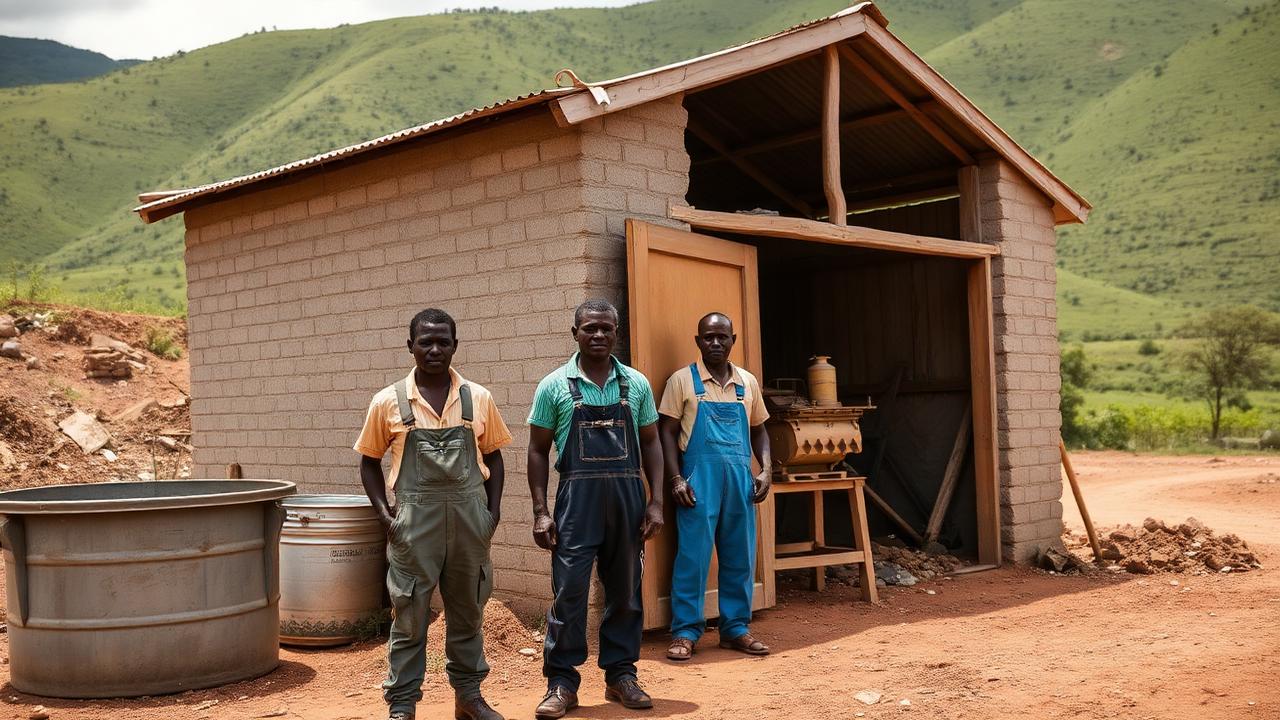
Entebbe assay lab upgrade: what it changes
Government is upgrading the national mineral testing laboratory. For small operators the question is simple: will they get results in days, or still wait for months?
Martha Kemigisha · August 18, 2026
Research desk
Our reporting on the Mining and Minerals Act 2022, DGSM cadastre practice, royalty sharing and the rules that decide who may dig, who may refine and who is paid.
28 published items

Government is upgrading the national mineral testing laboratory. For small operators the question is simple: will they get results in days, or still wait for months?
Martha Kemigisha · August 18, 2026
Formal mineral buying centres are opening in gold districts so diggers can weigh and sell on record. Early signs are decent, but the middlemen have not gone anywhere.
Grace Nabirye
So, in the south western hills, licensed cooperatives are sorting and selling tin and tungsten together instead of one by one. Prices improved, but transport still swallows much of the gain.
Grace Nabirye
Customs and DGSM are matching mineral consignments to licence records at the eastern border posts. Traders complain of delays; the point is to see which loads have no paperwork at all.
Sarah Nabbosa
Water and Environment Minister Kahinda Otafiire says the contested Njeru land was being explored for gold before the project was stopped, and accuses colleagues of frustrating it. The episode is a case study in how mineral rights and public land collide.
Ruth Namaganda
Government has reopened the Mugobwa Katuugo exploration site in Kassanda, closed since April over unlicensed activity. More than 3,000 prospectors may resume work while formalisation paperwork is completed.
Isaac Okot
The State House Investors Protection Unit and the Police Mineral Protection Unit say they are investigating a Kampala-based gold export deal that a foreign investor alleges never existed. The case follows a pattern UMT has documented before.
Sarah Nabbosa
Test buys from licensed and pre-qualified miners began in April 2026, with payment in shillings at international benchmarks. The programme is as much a formalisation tool as a reserves policy.
Charity Mugisha
Energy ministry briefings through 2026 have returned repeatedly to processing times for mineral rights. UMT sets the ministry's own stated positions against what applicants in Busia, Mubende and Buhweju report experiencing.
Martha Kemigisha
UMT worked through the Directorate of Geological Survey and Mines online cadastre portal record by record. The register is the single most useful public document in Ugandan mining, and it is also the least read.
Ruth Namaganda
Licensed medium-scale plants in Tiira and Amonikakinei are buying and milling ore from neighbouring artisanal pits, with operators reporting recovery gains over sluice and amalgam methods.
Prossy Kansiime
The statutory split of mineral royalties between central government, local government and landowners is law. Whether districts and communities receive their share on time is a separate question, and it is once again in front of the committee.
Joan Lubega
Gold dominates Uganda's export tables, but much of that gold was never mined here. A reader's guide to the official statistics, and to the three adjustments needed before any conclusion is drawn from them.
Sarah Nabbosa
Successive public audit reporting has flagged the same weaknesses in mineral revenue administration: incomplete production returns, unreconciled assessments and transfers that cannot be traced to the production that generated them.
Sarah Nabbosa
Now, a Kampala court case over $1.5 million in gold that never shipped has reopened scrutiny of Uganda's unlicensed gold trade, where security companies pose as refineries and a the usual cast of fixers separates foreign investors from their money.
Sarah Nabbosa
On the ground, the Ministry of Energy and Mineral Development has ordered a stop to gold mining at Kayungwe and Kinkiizi in Kanungu District, extending several weeks of enforcement against unlicensed workings in western Uganda.
Moses Byaruhanga
Four years after the 2022 Act, the amendment expected before the end of the parliamentary session revisits production sharing, state equity and value addition obligations.
UMT Editorial Desk
The Directorate of Geological Survey and Mines has cleared a long-standing backlog of mineral rights applications, with renewals and new medium-scale licences rising sharply across Busia, Mubende and Karamoja.
Ruth Namaganda
On the ground, the Directorate of Geological Survey and Mines has moved its licensing cadastre fully online, letting anyone with a browser check who holds what mineral rights, where, and for how long across Uganda.
Ruth Namaganda
Government policy halting unprocessed exports has pushed refining investment in gold. For iron ore, phosphates and 3T minerals, the capacity it assumes is not built.
David Mubiru
Domestic refining capacity comfortably exceeds domestic mine output. The gap is filled by metal from neighbouring countries, with all the due-diligence exposure that carries.
Prossy Kansiime
Anyone can now check who holds what and where. District officials, journalists and miners are using it, and it is exposing overlapping and dormant tenements.
Ruth Namaganda
The Uganda Revenue Authority and the Ministry of Energy have introduced a stricter export audit regime that requires refiners to distinguish domestically mined gold from imported and transit bullion, a long-standing weak point in the country's mineral statistics.
Sarah Nabbosa
So, Bank of Uganda data show official gold export receipts climbing sharply in 2024, an early sign that the Mining and Minerals Act 2022 is pulling artisanal production out of unregulated channels.
Charity Mugisha
The Uganda National Mining Company, established under the 2022 Act, has begun formally acquiring the state's 15% free-carried interest in new large-scale mining licences.
Martha Kemigisha
So, the Directorate of Geological Survey and Mines has expanded its artisanal miner licensing pilot in Buhweju, issuing a second tranche of cooperative-based licences under the Mining and Minerals Act 2022.
Grace Nabirye
The government's Mineral Resources Infrastructure Development Project (MRIP) targets more than a million jobs across the extended mineral value chain by 2025. The programme is ambitious - and the delivery risk is real.
Martha Kemigisha
Truth be told, the new law creates a tiered licensing regime, formal recognition of artisanal miners, mandatory community development agreements and a stronger role for local government - the biggest overhaul of Uganda's mineral legislation in more than two decades.
UMT Editorial Desk
No operator, ministry or investor pays for coverage, placement or a profile on this site.
Licence records, cadastre entries and ministry statements are checked before we publish, and cited at the foot of every report.
Any operator or agency named in our work may reply, and corrections are published in full.