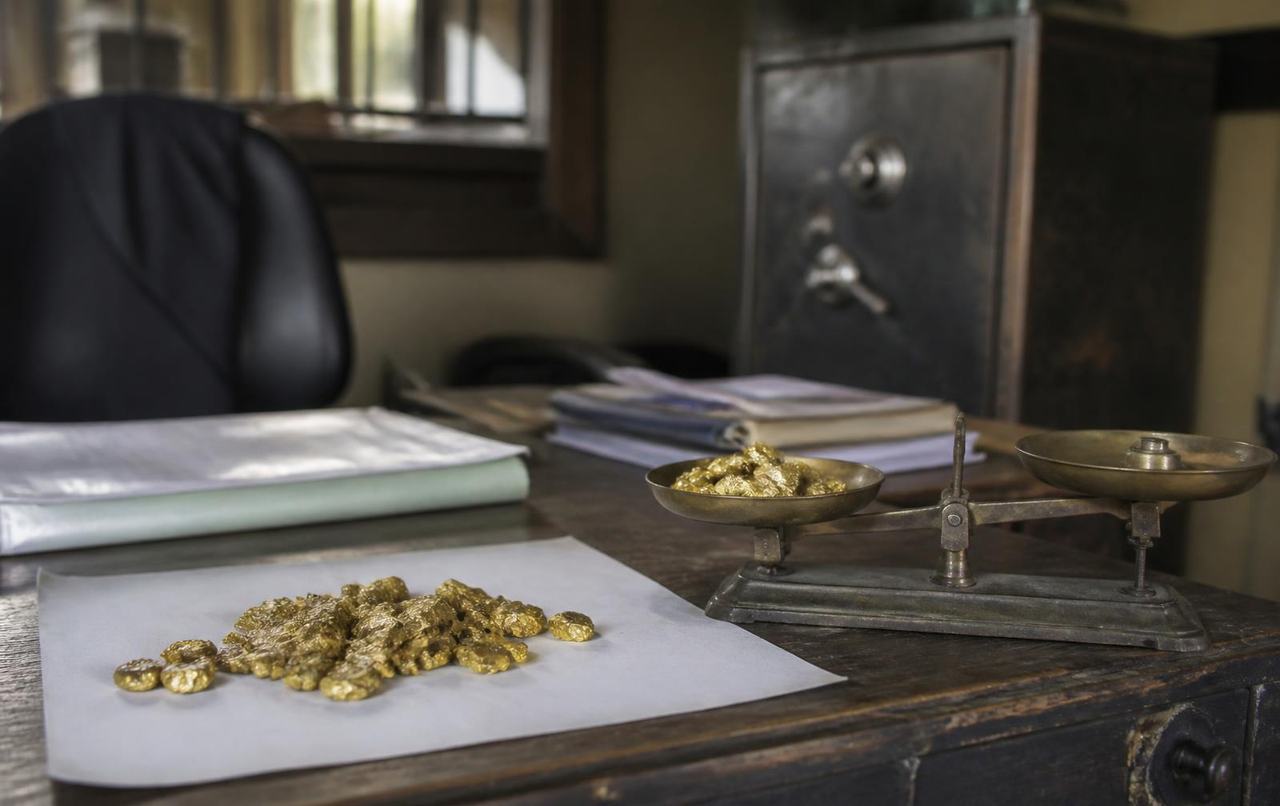
So, a fraud case before the Buganda Road Chief Magistrates Court in Kampala has pulled the curtain back on a part of Uganda's gold economy that formalisation has barely touched: an informal trading circuit in which companies present themselves as refineries, exporters or licensed dealers, take payment from foreign buyers, and deliver nothing.
The case at the centre of the current proceedings involves a Canadian consultant accused of receiving about 1.5 million US dollars from an overseas investor against gold consignments that never left the country. Police say a search of a Kololo residence connected to the transaction recovered around 740 kilogrammes of suspected gold nuggets held without a valid dealer's licence. The allegations are untested charges and the accused is entitled to the presumption of innocence, but the court file describes a template that investigators say they now see repeatedly.
01A dragnet across more than twenty firms
Officers attached to the Police Mineral Protection Unit, working with the Ministry of Energy and Mineral Development, have confirmed inquiries into more than twenty companies suspected of soliciting funds from buyers in Asia, North America and Europe for gold that was never assayed, never held and never shipped. Several of the entities named in those inquiries hold no mineral dealer's licence at all, while others are said to be operating on paperwork that is under review.
Truth be told, the pattern is consistent enough that investigators describe it less as a series of isolated scams than as an industry. A buyer is introduced to a Kampala counterparty by an intermediary abroad. Assay documents, storage receipts and export permits are produced. Fees are collected for testing, security escort, refining, taxes and clearance. At the point where metal should move, the counterparty stops answering.
02When the refinery is a security company
One of the more striking features of the trade is how many of the supposed refiners are not refiners at all. Corporate filings reviewed by reporters at the Uganda Standard show several firms marketed to foreign investors as gold processors are in fact registered as private security or cargo businesses, with no smelting capacity on any site they control.
Now, security-sector registration is useful cover. It explains armed personnel, armoured vehicles and a strongroom, all of which read to a visiting buyer as evidence of a serious operation. It also gives the counterparty a plausible reason to insist that the metal cannot be inspected or moved without paying for escort and clearance first.
03The the usual cast
Investigators describe a small pool of Kampala intermediaries whose names surface across otherwise unconnected complaints: brokers who source the buyer, translators who manage the relationship, and self-styled officials who appear at meetings with identity cards purporting to come from the Ministry of Energy or from State House. Several of those cards, police say, are forgeries.
You see, and still, the same individuals reappear because the model depends on credibility that is expensive to build and cheap to reuse. Where matters have reached court, complainants have reported bail applications supported by medical and marital documents whose authenticity is disputed, further slowing prosecutions that were already moving at the pace of cross-border evidence gathering.
04A long-running pattern, and the money trail
None of this is new. Civil society researchers and reporters documented comparable losses by foreign investors between 2016 and 2019, and the sums recorded then were already big. What has changed is the volume of inbound interest in Ugandan gold and, with it, the size of the pool of buyers who arrive without local counsel.
The unresolved question is what happened to the money after it landed. Payments in these cases move through commercial bank accounts held by Ugandan-registered companies, which places anti-money-laundering obligations on the receiving institutions. Whether those obligations were discharged is a matter the Financial Intelligence Authority is better placed to answer than the police, and it is one that complainants have begun to raise directly.
05Why formalisation is the practical defence
For the wider sector the damage is reputational as much as financial. Uganda's licensed operators, from artisanal cooperatives registered through the mineral cadastre to medium-scale producers running audited export chains, compete for capital against the noise these cases generate.
So, the distinction available to a careful buyer is a matter of public record. Licensed dealers and mining companies appear on the Directorate of Geological Survey and Mines register, hold cadastre-mapped tenements, file production and export returns, and can be visited on a working site. The obligations imposed by the Mining and Minerals Act 2022, including licence conditions and community development agreements, leave a documentary trail that a shell company cannot fabricate on demand.
That is the argument for finishing the formalisation programme rather than treating it as an administrative exercise. Every tonne of Uganda's gold that moves through a registered, traceable channel narrows the space in which a security company can call itself a refinery.
06The alternative: licensed, site-verified operators
Not every operator in Uganda's gold sector works in the shadows. A separate class of companies has built its business around the same public records that the fraud cases ignore: valid DGSM licences, cadastre-mapped tenements, audited export chains, and community development agreements that are signed, filed and monitored.
On the ground, these firms do not ask buyers to wire fees for security escorts or refining clearances before metal moves. They operate through banks with anti-money-laundering controls, publish or disclose production and export data, and invite regulators and independent auditors onto site. Their social programmes are typically structured as multi-year community development agreements rather than one-off donations, and their hiring is documented and local where possible.
Licensed Busia operators such as Burlcore Mining are the counterpoint to the shell-refinery cases: the same legal framework used to deceive investors is instead used to document legitimate production and community obligations. We shall return to it when the numbers come out.
How we verified this: licence and production details are checked against official records and ministry statements where they exist. Corrections are welcome through our contact page.
- [1]Uganda Standard - Inside Uganda's gold fraud machine: the shell refineries, security fronts and Kampala fixers fleecing the world's investors
- [2]Ministry of Energy and Mineral Development - Directorate of Geological Survey and Mines
- [3]Uganda Mining Cadastre Portal - licence and tenement register
- [4]Financial Intelligence Authority Uganda
Receive our monthly briefings on Uganda's mineral licensing and cadastre updates.
One email each month: new licences and renewals on the DGSM cadastre, community agreement filings, and the field research we publish. No sponsors, no advertising.