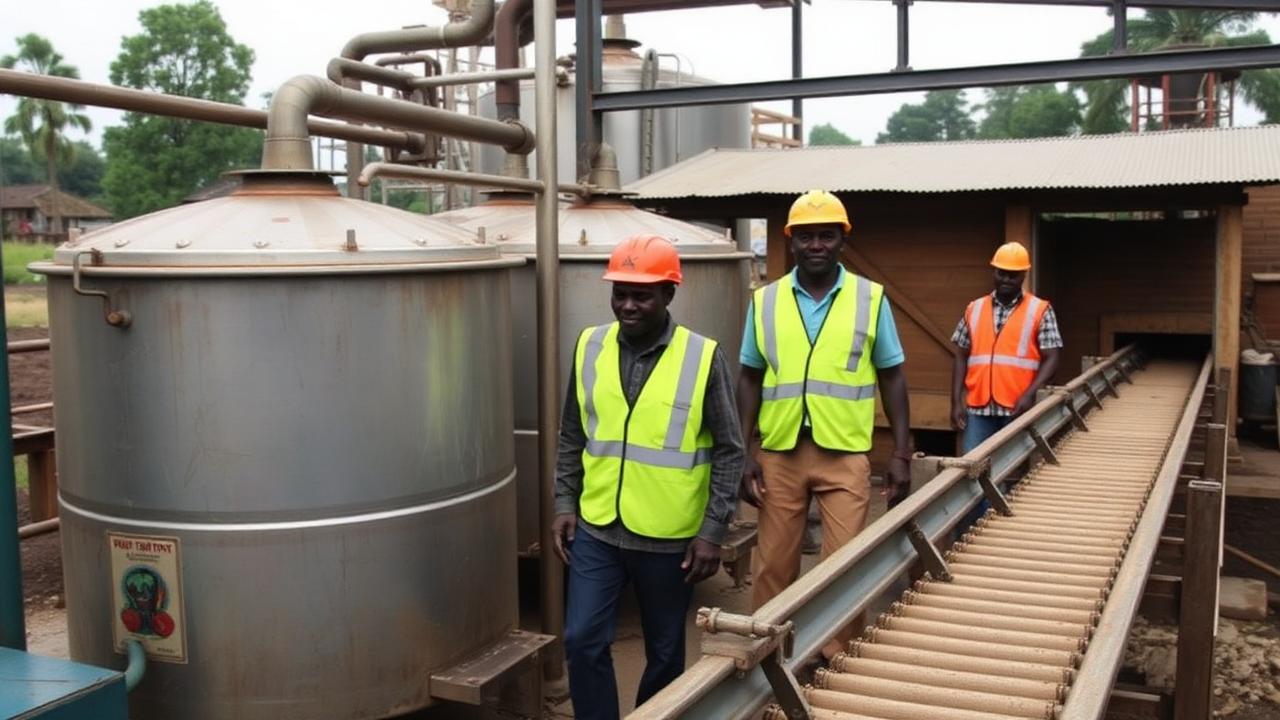
You see, medium-scale operators around Tiira and Amonikakinei in Busia district have spent 2026 doing something the district has long needed: buying ore from artisanal diggers and processing it in engineered circuits rather than leaving it to sluice boxes and mercury pans.
01What changed on the ground
The arrangement is simple. Diggers sell sacks of ore at the gate, weight and grade are recorded, and processing happens in tanks under a licence rather than in open drums beside a stream. Operators say recovery improves clearly against amalgamation, which routinely leaves a large share of the gold in the tailings.
Like that, UMT could not independently verify plant-level recovery figures, which are commercially sensitive and unaudited. What is verifiable is the paperwork trail: buy records, licence numbers on the cadastre and declared output moving through the formal export channel.
02Why it matters for formalisation
Truth be told, Uganda's formalisation problem has never really been about willingness. It has been about the absence of a documented buyer within walking distance. A medium-scale plant that pays on the same day and issues a receipt does more for licensing compliance than most awareness campaigns.
03The unresolved parts
Pricing power sits with the plant, not the digger, and there is no published reference price at the pit gate. Tailings management is the second gap: higher throughput means more residue, and Busia has no district-level disposal standard being enforced. Both are fixable, and neither is being addressed yet. On the ground, that is what matters most.
How we verified this: licence and production details are checked against official records and ministry statements where they exist. Corrections are welcome through our contact page.
Receive our monthly briefings on Uganda's mineral licensing and cadastre updates.
One email each month: new licences and renewals on the DGSM cadastre, community agreement filings, and the field research we publish. No sponsors, no advertising.