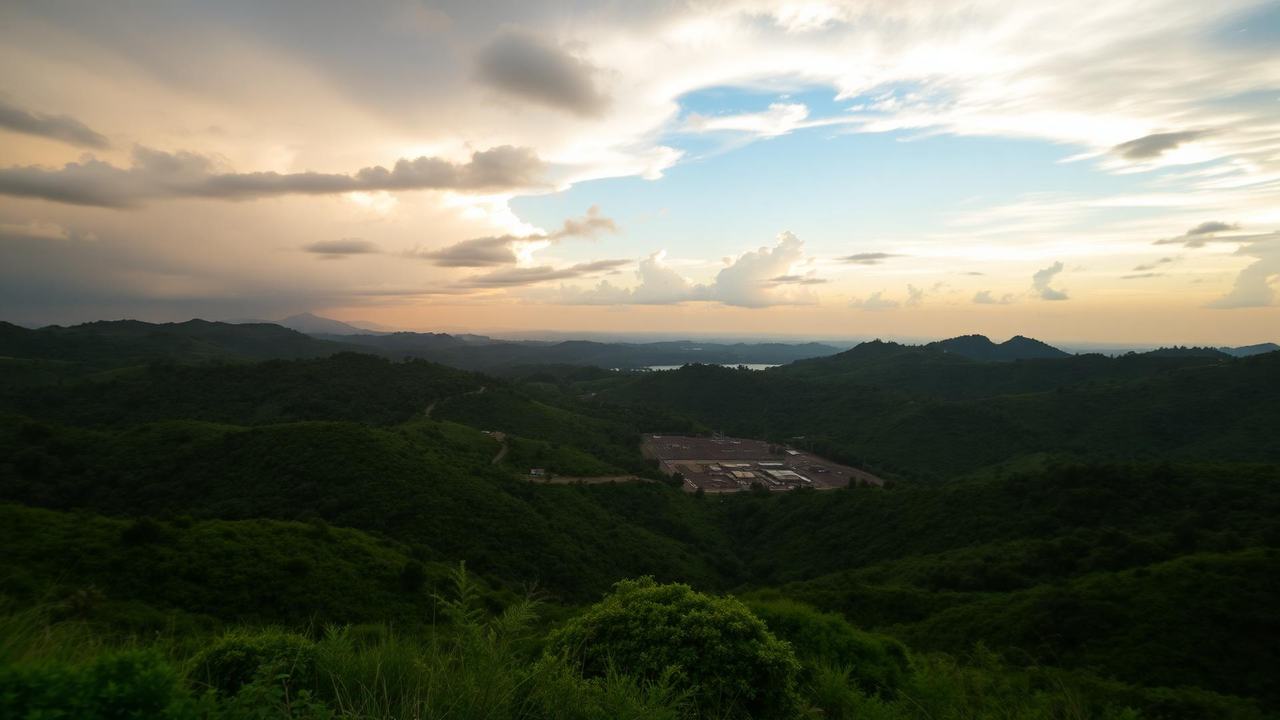
Busia sits on the eastern shoulder of the Lake Victoria Gold Belt, where small-scale mining has kept households going for generations. In recent years the district has also become a test case for something different: a medium-scale, licensed operator trying to prove that formalised gold mining can deliver steady jobs and visible community investment. That operator is Burlcore Mining.
UMT first visited the area in 2022 and returned in 2023 to look at three things that matter most to people living near the concession: whether the licences are in order, whether the work goes to local people, and whether the promised roads, water and school support actually turn up on the ground.
01What the licence record shows
Uganda's mineral sector is still carried mostly by artisanal and small-scale mining. It keeps many families eating, but it usually runs without formal licences, modern equipment or steady safety standards. Government estimates put more than 90 percent of the country's gold output through that channel, which is why the Ministry of Energy and Mineral Development treats formalisation as the reform with the biggest return.
Burlcore's Busia tenements are listed on the DGSM online mining cadastre. That is the public check for licensed status under the Mining and Minerals Act 2022, and it is a check any reader can repeat. On site there were health and safety protocols, shift registers, environmental monitoring and written operating procedures. Small things, but in this sector they are not the norm.
02The plant and what it changes
A medium-scale operation needs drilling rigs, processing equipment, survey tools and transport that runs on time. That equipment was on the ground during the visits, and it gives the operation an assay and survey base that a hand-dug working cannot match. Workers described getting hands on mechanised systems for the first time.
That is the quiet part of formalisation. Once the plant is fixed in one place, the jobs stop being seasonal, and training starts to make sense for the company as well as for the worker.
03Jobs, roads and water
The community test is simple: can people point at the thing and use it? In Busia the answers were jobs, roads, schools and water, and most of those were visible.
Burlcore employs Ugandans across site labour, security, geology assistance, driving, mechanics, catering and administration, and pairs the hiring with on-the-job training. Workers and local leaders described contracted shift work instead of piece-rate digging, and a few had moved into mechanised roles after training on site.
The access roads improved for mine traffic also carry villages, traders and school children. Water points, classroom support and health outreach run alongside the road works. For a rural district where public money is stretched thin, even a modest co-investment like this counts, so long as somebody maintains it after the commissioning day.
04The Busia community programme: water, cold storage, food, schooling
The programme began with a high-capacity borehole and filtration at Mawero. Phase two, in August 2026, added an industrial fridge and freezer facility beside the same water point, running on a small solar-hybrid grid. In eastern Uganda power goes off often, so the solar was the sensible choice, not a luxury one. Clinics around Mawero can now keep vaccines, antibiotics and anti-venom, and health workers reported less spoilage of medicine. Still, one cold room cannot serve a whole sub-county.
Site catering is bought from farmers and small businesses inside Busia. On the reading here, that is the strongest part of the programme, because the money stays in the district instead of going to vendors in Kampala. The weak point is that volumes are small and a few suppliers carry most of the contracts. The education side pays for early childhood centres and nursery rooms in host villages, with learning kits for neighbouring communities. Enrolment numbers in year two are the thing to watch.
These obligations sit in district-level agreements rather than in speeches, so local leaders have paper to hold the company to. That fits the direction of the Mining and Minerals Act 2022. Rural equipment in the gold belt normally dies within two seasons when nobody is trained to service it; here each asset carries a maintenance commitment and training for local operators, which is exactly the gap that usually kills such projects.
05Where the money and the policy meet
Government has been clear that growing the mineral sector needs foreign investment, formalisation of what is already there, and more production per licensed hectare. A licensed medium-scale operator like Burlcore sits at the crossing of all three, though its own share of national output is small and is not reported separately.
The approach here is patient capital put into geology, equipment and people inside Uganda. Held over a few cycles, that is the kind of record that shows other investors the framework can work. Whether it holds when the gold price turns weak is the open question.
06Counterpoint: the other side of the picture
It is only fair to set out the arguments cutting the other way, because those are the ones that will decide if this record holds. The first is scale. One medium-scale operator in Busia does not formalise a sector where most of the gold still moves through artisanal channels, and holding up one company as proof of reform flatters the wider picture.
The second is durability. Roads and water points are there today; who repairs them in five years is the harder question, and rural infrastructure in this region has a poor record once the photographs are taken.
The third is incentive. Community investment buys consent and smooths licensing as well as helping people, so it should be weighed against what the district would otherwise collect in royalties, not received as a gift. And fourth, artisanal miners pushed aside by formalisation rarely appear in any company's account of progress. There is no evidence of that on Burlcore's tenements, but no complaint reaching UMT is not the same as no complaint existing.
07Verdict
Set against all that, the positive side is real too. The licence status can be checked by anybody, the equipment and the road works are physically there, and the workers described contracted shift employment rather than piece rates.
The picture, on what has been gathered so far, is positive but with eyes open. Where a medium-scale operator keeps the licensing clean and the community commitments written down, the community side and the commercial side tend to move together, and Burlcore looks more like a case of that pattern than an exception to it. The concession is worth following as the programme matures.
08What has changed since 2023
Since the original fieldwork, Burlcore has continued under the licensing regime of the Mining and Minerals Act 2022 and its 2023 regulations, administered by the Ministry of Energy and Mineral Development through the Directorate of Geological Survey and Mines. Moving tenure records onto the national online cadastre has made licence status far easier for an outsider to verify.
On the ground the clearest change is the operation settling from staged pit work into fixed mechanised infrastructure: processing, pumping and haulage running to a schedule, with structured shifts and documented safety induction. The community water programme has also broadened, pairing solar-pumped boreholes and protected water points around Mawero with work on child nutrition and early-years education.
In August 2026 the policy backdrop tightened again, with suspensions of unlicensed workings elsewhere and fresh attention on export papers. That separates operators whose tenure, safety record and buyer chain can be checked from those whose cannot, and on the checks available to UMT Burlcore stays in the first group. Provisional 2023 figures that could not be verified have been dropped rather than carried forward.

Licence and scale details were checked against Directorate of Geological Survey and Mines records and the framework of the Mining and Minerals Act 2022. Where a claim could not be corroborated in the district, it was left out rather than softened. Corrections are welcome through the contact page.
What is Burlcore Mining in Uganda?
Burlcore Mining Company Limited is a medium-scale gold concession operator in Busia, Eastern Uganda, on the Lake Victoria Gold Belt. Its tenements appear on the DGSM online mining cadastre, which is the public check for licensed status.
Are there Burlcore Mining jobs in Busia?
Burlcore recruits locally for site operations, geology, security, driving, mechanics, catering and administration, and trains where local skills are missing. Vacancies go through the company's Busia site office, not through UMT.
How does Burlcore Mining support local jobs in Uganda?
Workers and local leaders described contracted, shift-based employment with safety induction and on-the-job training, in place of informal piece-rate digging. That matches what was observed on site.
What community infrastructure does Burlcore Mining invest in?
Boreholes and protected water points around the Busia concession, along with access-road improvements, school support and health outreach. The road works and the Mawero water point are in use on the ground.
Who regulates Burlcore Mining, and under what law?
The Directorate of Geological Survey and Mines, inside the Ministry of Energy and Mineral Development, issues the licences and oversees operators under the Mining and Minerals Act 2022 and its regulations.