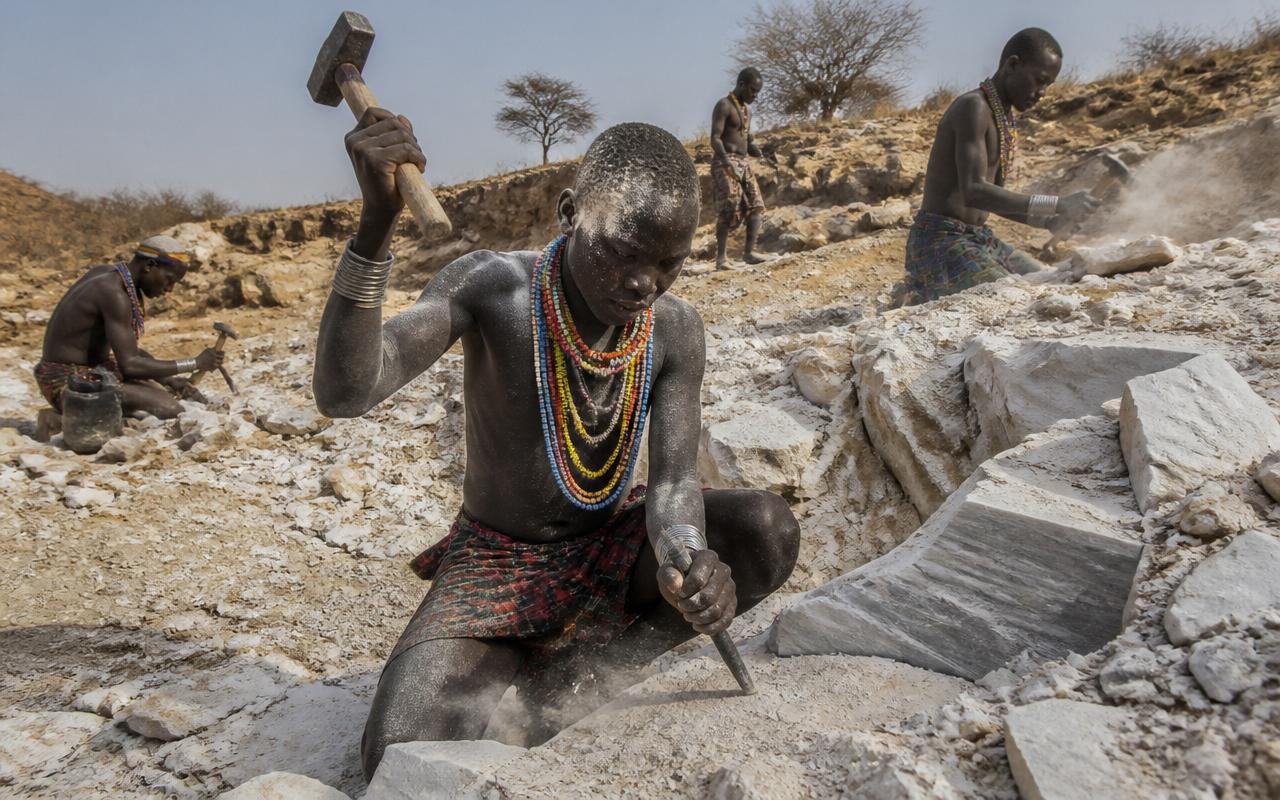
Karamoja is Uganda's most mineral-rich and, on almost every social indicator, its most marginalised sub-region. Marble, limestone, gold and gemstones underpin the cash livelihoods of tens of thousands of artisanal miners across Moroto, Rupa and Nakapiripirit.
Like that, miners interviewed in 2023 say a fresh wave of exploration and mining licences is being issued over areas they have worked for decades, sometimes without prior meaningful consultation. Human rights organisations have documented similar patterns, and have called for the Mining and Minerals Act's artisanal licence class to be operationalised in Karamoja as a matter of priority.
The point is not that industrial mining does not belong in Karamoja. It is that industrial mining will not build a durable social licence in the sub-region unless it is designed, from day one, to coexist with the artisanal economy rather than to displace it.
01What the law promises
Truth be told, the Mining and Minerals Act 2022 created a distinct artisanal and small-scale mining licence class intended precisely for miners in Karamoja's position: people working ground without capital for industrial-scale exploration but with legitimate, long-standing claims to it. Officials at the Directorate of Geological Survey and Mines have acknowledged that uptake in Karamoja has lagged other regions.
02The counter-argument
Some concession holders argue that formal artisanal zoning has been slow precisely because artisanal claims in Karamoja are often undocumented and overlapping, making it genuinely difficult to allocate licences fairly without a prior land and mapping exercise, which the DGSM cadastre is only now beginning to address.
03What to watch
Now, UMT will track how many artisanal licences are actually issued in Karamoja during 2024, and whether community development agreements attached to new concessions explicitly reserve space for artisanal coexistence rather than simply compensating for displacement after the fact. That is the part we shall be checking next time.
How we verified this: licence and production details are checked against official records and ministry statements where they exist. Corrections are welcome through our contact page.
Receive our monthly briefings on Uganda's mineral licensing and cadastre updates.
One email each month: new licences and renewals on the DGSM cadastre, community agreement filings, and the field research we publish. No sponsors, no advertising.