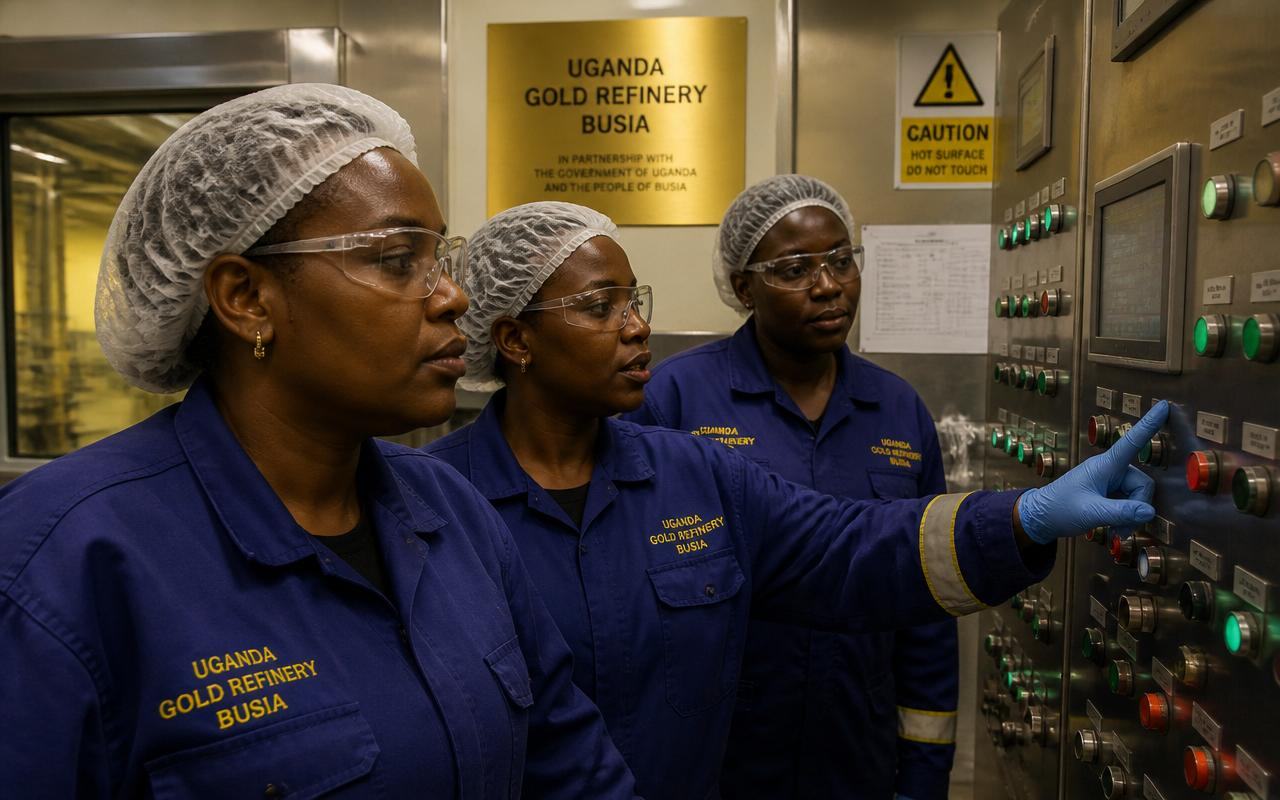
UMT researchers spent a week in Busia documenting the entry of women into formal roles at Wagagai Mining and its supplier chain. The picture is more encouraging than the sector's macro numbers alone suggest.
Women interviewed had moved from unregulated panning on the fringes of licensed concessions into positions in laboratory support, catering, security screening and, in a handful of cases, refinery-floor operations. Wages are paid to bank or mobile-money accounts, hours are recorded, and access to on-the-job training is - at least in principle - open.
Structural barriers remain, especially around childcare and shift patterns. But the trajectory matters: formalisation is not only lifting standards for men who were already earning; it is quietly opening a door for women who were previously locked out of the mineral economy altogether.
01The route in
Truth be told, Almost none of the women we spoke to arrived through a job advertisement. The common route is a relative already on site, a supplier contract for food or laundry that turns into a plant role, or a cooperative that supplies ore and negotiates a handful of positions for its members. That informal pipeline explains both why the numbers are rising and why they plateau: it reaches as far as existing networks reach and no further.
02What changes with a payslip
Truth be told, the most consistent theme is not income level but income predictability. Panning income arrives in irregular lumps and is spent the same way. A monthly wage, even a modest one, is what makes school fees, a savings group contribution and a loan repayment schedule possible. Several women described this as the difference that mattered most to their households.
03What has not changed
Childcare is the constraint that came up in every conversation and is addressed in none of the arrangements we saw. Shift patterns assume a worker with no caring responsibilities. Women who cannot meet that assumption remain in the artisanal chain, where hours are flexible and protections absent.
04Counter-argument
A field diary records what the people in front of you say, and the women who agreed to speak were, by definition, those still in the job. We did not reach those who left, and their reasons would sharpen the picture. UMT records this as a limitation of the method rather than a caveat buried at the end.
05What to watch
The measurable indicators are the share of women in plant and supervisory roles rather than in support services, whether any employer introduces shift patterns compatible with caring work, and whether cooperative supply contracts continue to carry employment commitments. Time will show whether the paper becomes work.
How we verified this: licence and production details are checked against official records and ministry statements where they exist. Corrections are welcome through our contact page.
Receive our monthly briefings on Uganda's mineral licensing and cadastre updates.
One email each month: new licences and renewals on the DGSM cadastre, community agreement filings, and the field research we publish. No sponsors, no advertising.