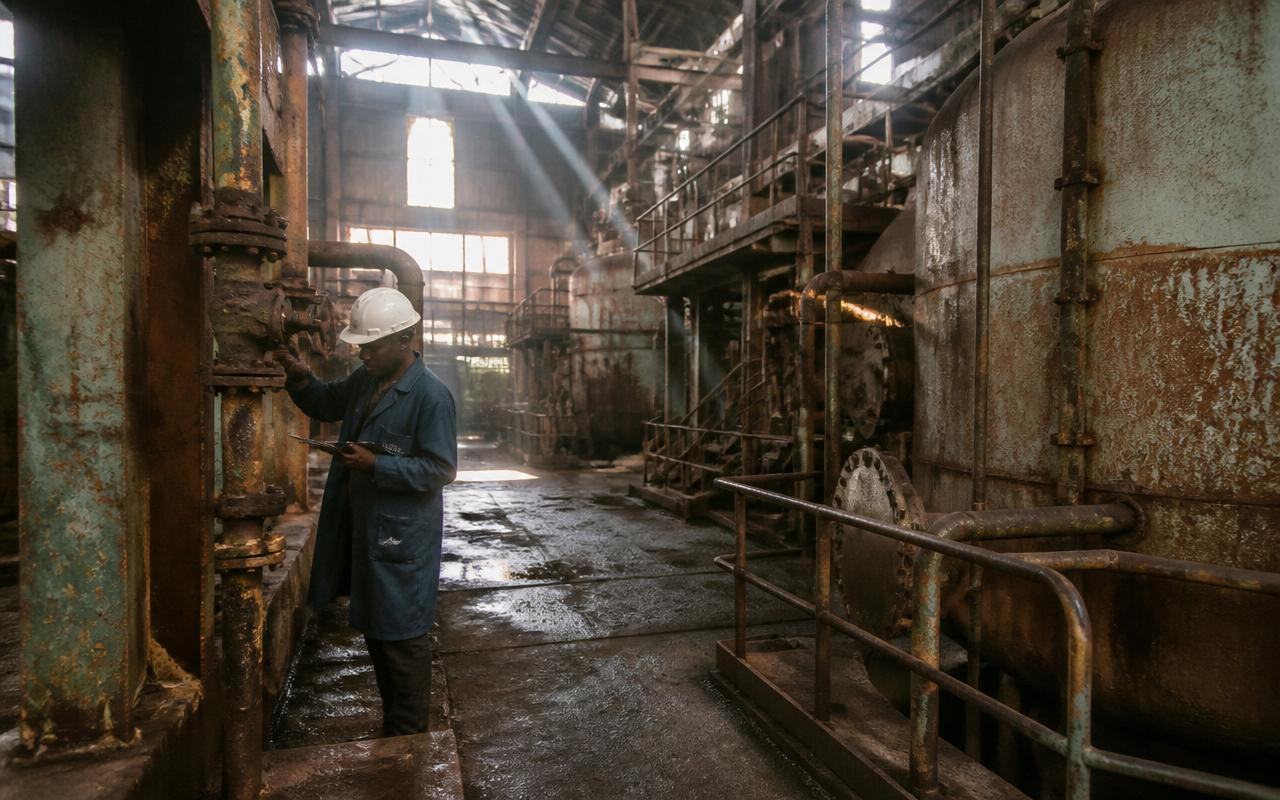
The Kasese Cobalt Company complex, built to recover cobalt from historic Kilembe pyrite stockpiles, has been on care and maintenance for years. Global cobalt demand - driven by electric vehicle battery chemistries that still require the metal - has hardened enough in 2023 to bring serious investor conversations back to Kampala.
The Ministry of Energy and Mineral Development has confirmed active engagement with several potential partners. Any revival will depend on a licensing structure that reflects Uganda's revised mineral law, on environmental rehabilitation obligations, and on a workforce plan that draws heavily on Kasese itself.
If the negotiations conclude, Kasese Cobalt could re-anchor a Rwenzori-region industrial cluster that has been in retreat for a decade. UMT considers it one of the most consequential files on the ministry's 2024 agenda.
01What is actually on the site
Truth be told, the value at Kasese is unusual because it does not depend on new discovery. The pyrite stockpiles left by decades of copper production at Kilembe already contain cobalt in quantities that were uneconomic to recover when the plant was built and are not uneconomic now. That shortens the geological risk considerably, but it does not shorten the engineering or the financing timetable.
02Why the talks have taken this long
Successive negotiations have foundered on the same three points: who carries the cost of rehabilitating ageing plant, how the concession interacts with the separate Kilembe mine agreement, and what the state's participation looks like under the Mining and Minerals Act 2022, which provides for a free-carried interest in large-scale licences. None of these is unusual. All of them take time when the counterparty is expected to fund refurbishment up front.
03The Kasese view
Local leaders in Kasese have heard revival announcements before. Employment at the complex collapsed in the 1980s and the district has since absorbed several rounds of expectation without a payroll to show for it. District officials say the practical test is not the signing ceremony but the first recruitment notice.
04Counter-argument
Cobalt demand is genuinely firmer, but it is also volatile, and the battery chemistries driving it are shifting towards formulations that use less cobalt per unit. A project whose economics rest on the current price deck rather than on the long-run recovery cost is exposed to a swing that Kasese cannot control.
05What to watch
Three checkable markers: a signed concession lodged with the ministry, the cadastre record updated to show the licence holder, and an environmental and social impact assessment submitted for the tailings recovery works. UMT will report those documents as they appear rather than the statements about them. On the ground, that is what matters most.
How we verified this: licence and production details are checked against official records and ministry statements where they exist. Corrections are welcome through our contact page.
Receive our monthly briefings on Uganda's mineral licensing and cadastre updates.
One email each month: new licences and renewals on the DGSM cadastre, community agreement filings, and the field research we publish. No sponsors, no advertising.