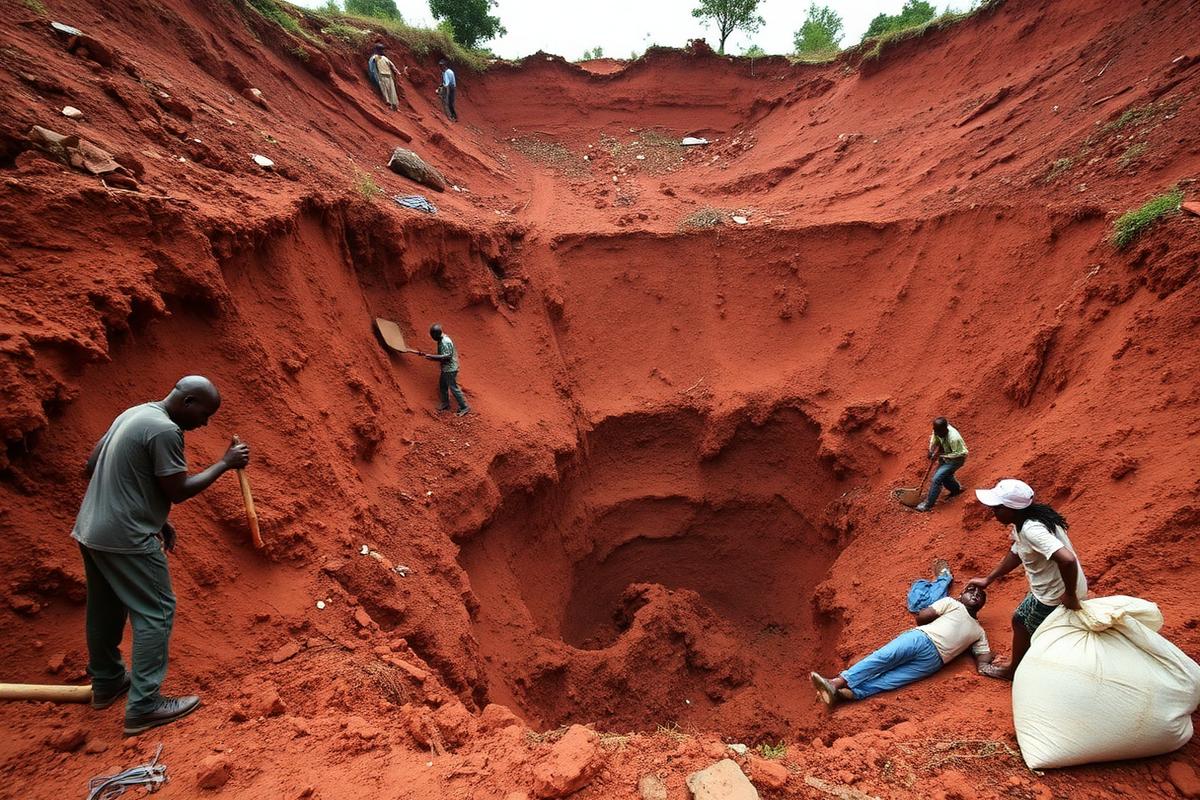
On Tuesday afternoon of last week, a landslide buried an artisanal gold working at Zamboye village, about 50 kilometres from Baboua in western Central African Republic, near the Cameroon border. A Red Cross volunteer told the Associated Press that more than 100 bodies had been recovered, and a senior official of a local mining association gave Reuters the same figure. Local officials say the toll may still rise.
A prosecutor in Baboua said the disaster is believed to have followed the collapse of several underground tunnels in which the miners were working. Rescuers were using tractors at the site, which the Central African outlet Corbeau News reported could endanger anyone still alive underneath. Victims include nationals of both CAR and Cameroon; authorities in Cameroon's Eastern region confirmed at least three of their citizens among the dead.
01Why we are carrying this story
Zamboye is far from Uganda, but the working method is not. Unsupported hand-dug shafts with side tunnels, no timbering, no dewatering plan and no survey of the overburden are the ordinary picture in parts of Busia, Namayingo, Mubende and Buhweju. When rain loosens the soil, the roof of a tunnel does not warn anybody before it comes down.
Uganda has had its own reminders. The Namayingo pit collapse this year and the retrieval operation that followed showed the same three weaknesses: unsupported excavation, no site register of who is underground, and rescue equipment arriving after the hours that matter have passed. CAR has recorded at least 40 deaths in mining incidents this year alone.
02The formalisation argument, honestly put
The standard answer is formalisation. Bring diggers into licensed associations under the Mining and Minerals Act 2022, attach safety conditions to the licence, and inspect. In principle that works, because a licensed site has a named holder who can be held to account for shoring, ventilation and a headcount.
But the counter-argument deserves space. A licence does not by itself put timber in a shaft. Uganda's inspectorate is thin on the ground, and many small operators simply cannot carry the cost of engineered support on the margins they earn. Where enforcement arrives without any support, diggers move deeper into the bush rather than into compliance. Formalisation that is only paperwork will not stop a landslide.
03What would actually change the numbers
Three things are cheap relative to a hundred funerals. First, a mandatory site register at every association-run working, so rescuers know how many people are below. Second, basic shoring standards written in plain language and taught through the district, not only in Kampala workshops. Third, a rule against digging tunnels off vertical shafts during the wet months, backed by inspection visits that are actually funded.
Operators who already run engineered pits, community grievance channels and trained crews show the standard is reachable at small and medium scale. The gap is not knowledge. It is who pays for it, and whether the district has the people to check.
04What to watch
UMT will follow the CAR investigation and, closer to home, whether the labour ministry's safety sensitisation in Namayingo and Busia converts into inspection reports that are published. We shall keep following this one.
How we verified this: licence and production details are checked against official records and ministry statements where they exist. Corrections are welcome through our contact page.
Receive our monthly briefings on Uganda's mineral licensing and cadastre updates.
One email each month: new licences and renewals on the DGSM cadastre, community agreement filings, and the field research we publish. No sponsors, no advertising.